Monday, November 7, 2016

Sri Vidya — From Desire to Identity (Advaita in Practice)


What is Śrīvidyā?

Śrīvidyā is understanding how this world came to be, and my role in it. It proves step by step that there is a collective consciousness like an ocean in which we swim like fishes, breathing in the waters of life. It also helps in understanding how a little drop can contain an ocean of which it is but a small part.

Is it important to learn it?

Śrīvidyā lets you feel the unbelievable wonder of your identity with Brahmā. Brahmā creates all our worlds with the help of Sarasvatī. She is the explosive flow of information. Brahmā is gravity which binds energy to a form. Information which can’t be bound by gravity is Sarasvatī. These are the two fields manifesting life: gravity and waves of presence, called information.

Śrīvidyā is derived from Strīvidyā (notice the extra “t”?), which means adoring nature consisting of the syllables:
s for sattva,
t for tamas,
r for rajas,
and i for desire.

Sattva means knowing, information.
Tamas means the ideas of who I am and who are my family members; in short, I and mine, which are limiting bondages.
Rajas means escaping binding, going out of boundaries of I and mine.
Desire doesn’t choose. It likes binding, gets bored of it and then likes freedom; it gets bored of it too. It keeps oscillating between sympathy and apathy.


If “t” for tamas is removed from Strī, it becomes Śrī, the wealth and pleasure of creating the world.

Śrīvidyā helps to let go of bondage to material things, and to become pure information. Adoring nature without desire is Śrīvidyā. It does not run after objects of desire, neither does it reject them. It does enjoy them when they come, but without bondage.

Śrīvidyā transforms the fiery love of passion into an affectionate love like Mother Nature, which created and cares for all living beings. It gives freedom to love all. It discovers that if you really love some person, that person’s happiness should truly be your own happiness; it can only happen in identity of the lovers.

We can appreciate Śrīvidyā as teaching that “all is one”: non-duality = Advaita in practice.

Guru Garu Katha


Sunday, November 6, 2016

Guruji Katha


Various kathā of Guruji
Collected by one of his disciples, Vikram


The complete dīkṣā nāmam given by Avadhūta Gurugaru to Devīpuram Guruji, soon after pūrṇa dīkṣā:

Advaita Amṛtānanda Paramahaṁsa Parivrājaka Ācārya Digambara Avadhūta Athivarṇāmī Śrī Lā Śrī (108 times) Mahā Maṇḍaleśvara


You can kill the lust by saturating it completely; this is the non-traditional way, the rebellious path, Kaula-mārga.


Me, world, Śiva, Śakti are all illusions. This is the greatest vidyā. I don’t exist. So I cannot be created, nor destroyed. Time, space, matter, knowledge, action don’t exist. This has been called Mokṣa.


How can you know that the world came out of you? You can see or know only if you have consciousness. What is consciousness? It is the mirror reflecting you to yourself. Because you are the world, you see the world. When you stop seeing the world as different from you, and that you are all, then you know that you can make the world you want, that you have a free will like God, that destiny is what you can create. You also know that you are the only person to consult when a decision is to be made. That makes deciding an extremely simple process.


The lowest level at which we understand the Śiva Liṅga is at the level of physical union. It is the male phallus which is called Śiva and the female yoni which is called Pārvatī. It is their union that we are worshiping. There, the union is for procreation.

At the next highest level, the fire in the navel center and the love in the heart center, their union is called Śiva and Śakti.

In the next higher level still, space is considered the womb and time is the liṅga which is moving. The universe of space and time is called the Śiva Liṅga.

All the five elements, all the ways in which we perceive, all these are considered to be liṅgas.

After these three levels, we reach the fourth and transcendent level where there is no distinction between the seer and the seen. They have become one. That is the highest form of the liṅga. It is called aliṅga. There is no liṅga there. There is no characteristic that differentiates one from the other. You are joined so totally with the world. You have absorbed the whole world into yourself and there is nothing other than you. So, to reach that state is called mokṣa.


What is consciousness? It is the mirror reflecting you to yourself.


She is the black hole — on Śavāsana Mahā Kālī.


In Devī you find the five senses which are the five arrows. These are the channels through which your mind can be disturbed. She holds them separate from the mind which is the bow. The bow and the five arrows are indeed the mind and the five senses. She holds them separately. She does not connect the arrow to the bow, which means that Devī represents the yogic state where you decouple your mind from disturbing sensory inputs. But even when this mind is decoupled from the senses, there is still another part of the mind which is the memory. The memory contains in it all the senses and it keeps on bringing these things up. All those things also have to be decoupled. The mind itself has to go. It is then that you are flowing in the cosmic awareness.


I am the one who points fingers at you and I am the one who defends you. I am the one who loves you and I am the one who scolds you. I am the one who insults you, and I am the one who compliments you. Learn to see me in the enemy and in the friend, because I exist in all.


Make your whole life a prayer.


He is a siddha luminary in the Śrīvidyā tradition. The secret Lalitā Sahasranāmam and even more secret Lalitā Triśatī were revealed to him by Hayagrīva, a form of Lord Viṣṇu. No less accomplished is his utterly beautiful wife Lopāmudrā, who is the seer of Hādīvidyā — on Agastya Muni.


 With devotion and intensity. You must be in love with Devī all the time. — on the key element to get siddhi in the mantras of the Cosmic Divine Mother


The entire creation is just a thought in the cosmic mind of Kālī.


I invoke all my gurus thru it — commenting on the Pādukā mantra of Avadhūta Gurugaru.


It’s like driving a speeding car without brakes — commenting when a disciple shared about his daily spiritual practices invoking multiple deities.


Because of recurring failures, you are losing faith. That is why it (ritual) is becoming mechanical, no feeling. Stop it for a couple of months. See if your situation improves.


Does anyone know what is enlightenment? We do not know enlightenment, but we know this life. Make heaven on earth now! That is the message of Tantra.


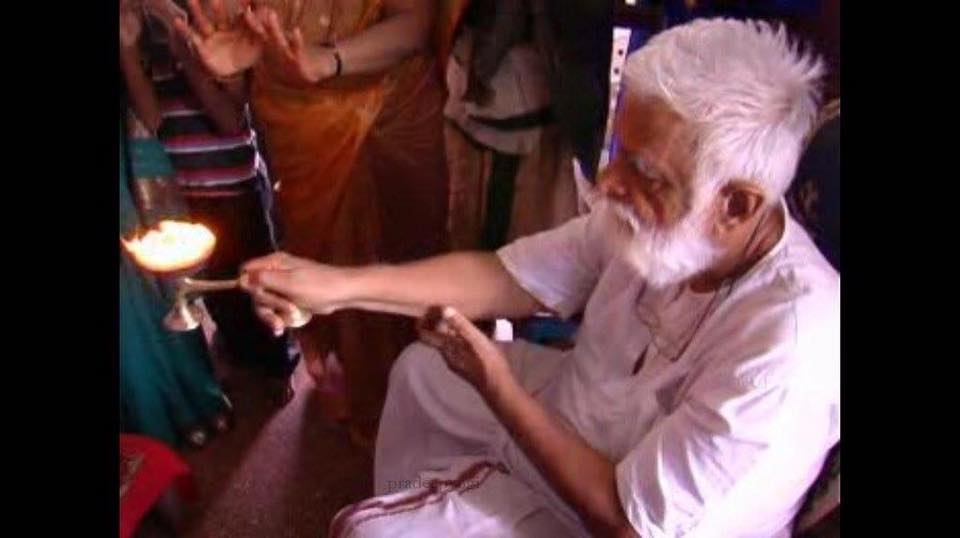
The last moments were constructed like this... Guruji stepped into the bathroom in the morning and then there was huge noise heard by Guru Amma (as we respectfully call his wife by), who rushed to the bathroom to see the Mahāsiddha sitting in Sukhasana, raising his finger upwards. Prior to this auspicious event of mahā samādhi, the great Guru did not even give a hint to his departure from physical realm, not even to his wife nor even to close disciples. But it was heard that Guruji did voice from past few years with few people about waiting for directive from Cosmic Mother to relieve his burden (he had single-handedly borne financial burden of building temple, solely trained and initiated disciples, etc., in spite of undergoing four heart attacks) to merge finally with Her. He, thru his mighty powers, did know the final dissolution of remaining karma (that binds one to earthly ties), and when he got the final command, with an utter dispassion (that only Sadāśiva has an unique attribute), left ...


Śakti doesn’t need Śiva; She can create numerous Śivas.


Be like a child, innocent and passionately alive in the moment.


Your aim is to raise yourself above your head, merge into that form, and experience unending spiritual orgasm, which you may call the dance of the galaxies, the dance of rising waterfalls, the divine light-and-sound show. The joy you experience will shower your whole body with a thrill you have never known before. The experience there is indescribable.


Bhakti means devotion. Bhakti Yoga is the path of devotion designed for persons in the emotional category. Generally misconstrued as a path of blind faith, superstitious belief, or mechanical ritual. People throughout the world follow all these rituals to attain God without probing into their validity.


If we are meditating upon Devī, I simply become Devī in Samādhi. As Devī receives worship by devotees, so do I. As Devī blesses people, so do I bless people. As Devī exists in all beings, so do I exist in all beings. All bodies are mine, all eyes, all hands, all feet, all skin, all senses, all experience are my experiences. There is none other than me and the Goddess of eros, and I worship myself through the union of the liṅga and yoni. Infinite intercourse with Śiva is my nature, unending orgasmic bliss is my rasa of Śṛṅgāra. Such is the experience of Samādhi. It is not void. It is not null. It is full. It transcends all life. It transcends all space and time. It is solidified knowledge, action, and desire. There is no movement in it, there is no birth, growth, or death, yet it is sum total of all possible experiences, of all life forms in all the worlds at all times.


The Guru is committed to take care of you (just like a husband/wife) as a soul mate. The real Guru, Goddess/God, speaks through the Guru, who can be either female or male. Don’t confuse the Guru with a physical form. The Guru of everyone is one and the same. And that is God/Goddess. Guru appears to different people in different forms, but the form is only a symbol. You have to look behind the symbol to the truth, and that truth is called Jagannātha. Jagat means world, Nātha means husband/wife, the husband/wife of the manifested world. The Guru is referred to as the husband/wife here, so that you can open up your body, mind, and soul without any inhibitions, for deepest truths can be learned without inhibitions.


Never be so closed-minded, because everyone is your Guru. This world exists as your Guru in many forms, until you realize that you are that.


That one thing which exists is consciousness. All forms, all space, all time, all materials, are merely forms of consciousness. That is not light, but it lights up everything for God to see. By it, objects such as Sun, Moon, stars, fire, etc., shine.


Śrīvidyā siddhi can be had only by people who have no desires. Not by others.


You will obtain everything only thru the Guru Pādukā mantra — a couple of years back at Dr. Rohira’s house in Bangalore city, Guruji impromptu listed out all the desires in my mind and then commented the above advice.

Sharing what little I know of Goddess


Sharing what little I know of Goddess…
That She is the art of creating new, better worlds…
That I feel like a baby sleeping contentedly in Her bosom after being fed by Her…
That She is my presence everywhere, all the time…
That She is born in my idea of Her, yet She gave me that idea first…

I think of Goddess like this. She is standing on top of my head facing the same direction as me. I catch Her feet with my hands and pull Her inside of me. Being a body of light, She comes in easily. Pray that She merges with me totally, replacing me with Her. Then Her thoughts are mine, Her knowledge is mine, Her power is mine. It is thus I pray. Give it a try.

Pray to Śakti to reveal Her secrets. If your compassionate mother doesn’t help you, who will?

Devī is the consciousness present in you, me, and in all of us, and everywhere. Because She is inside of us as life, our eyes see, ears hear, and we are able to propagate life. She is happy when we are happy, and unhappy if we are. So to get Her blessings, we have to say yes to our own happiness.

You are the Devīpuram, where Goddess lives.

Don’t run after siddhis. If we run after them, they will flee, but if we don’t seek them, they will seek you.

Knowledge is nothing but experience. Experience is nothing but totally involving yourself.

Varahi Puja


Syama Yantra Puja


Shyama manages cultural affairs of Lalita, the empress of the cosmos. Her upasana brings out abundance and fine arts to seeker. Idiot Kalidas worshiped Her. She wrote the kali bija aim on his tongue with her tongue. He became a great poet and sang the incomparable musical composition called Shyamala Dandakam. She transforms sexual lust to a caring love. She breast feeds nectar to those burning in the fire of Lalita's never ending desire to enjoy life and procreate called kama bhoga. She is adored in the tender, loving and caring heart center of motherhood in women. Lalita is best approached through Shyama.


Ganapati 444 Tarpanam


Get up early in the morning and worship the feet of the Guru on top of your head.

Aim Hrīm Śrīm—Aim Klīm Sauḥ
Haṃsaḥ Śivaḥ So’ham—hasakṣaphrem
Hasakṣa malavarayum hasaum
Sahakṣa malavarayīm sahauḥ
Svarūpa nirūpaṇa hetave svagurave
Śrī Annapūrṇāmbā sahita Śrī Amṛtānandanātha
Śrī Guru Śrī Pādukām Pūjayāmi Tarpayāmi namaḥ

Repeat once more. Imagine that from the feet of the Guru the cool flow of the Ganges water is flowing over your body.

Now imagine that in the center of your heart there is a shining ball of sun, orange in color, rising on the horizon. In that visualize the form of Mahā Gaṇapati, orange in color, and imagine that your whole body is filled with light, the surface of the body is just like a balloon and inside it is the orange light of Gaṇapati, and this glow is coming out of your body too.

Now do your morning oblations and offer a spoon of water to Mahā Gaṇapati in the sūrya (in the sun):

Om Tat Puruṣāya Vidmahe Vakratuṇḍāya Dhīmahi
Tanno Dantīḥ Pracodayāt.

Now finish your morning duties and then sit down facing east and make a pyramid (with a square base) of turmeric powder in a betel leaf or any leaf.

Invoke Gaṇapati into this, saying:

Om Tat Puruṣāya Vidmahe Vakratuṇḍāya Dhīmahi
Tanno Dantīḥ Pracodayāt.

Apply some kuṃkuma to the centers of four triangle sides of the pyramid.

Now take some pure water and put some tulasī in it. With the leaves of the tulasī do the following 444 tarpaṇas. This is the Caturāvṛtti Tarpaṇa. For each Tarpayāmi namaḥ offer a spoon of water on the Gaṇapati.

Sit comfortably on the ground. Keep your awareness at the junction of your seat and ground. Keep the Gaṇapati in front of you and the water to your right.

Gaṇapati Mūla Mantra

Om Śrīm Hrīm Klīm Glauṃ Gaṃ Gaṇapataye Vara Varada
Sarvajanam Me Vaśamānaya Svāhā Tarpayāmi namaḥ — 12 times

Do 4 tarpaṇas for each of the following sets:

  1. Om Svāhā Tarpayāmi namaḥ
    Om Śrīm Hrīm Klīm Glauṃ Gaṃ Gaṇapataye Vara Varada
    Sarvajanam Me Vaśamānaya Svāhā Tarpayāmi namaḥ

  2. Śrīm Svāhā Tarpayāmi namaḥ
    Om Śrīm Hrīm Klīm Glauṃ Gaṃ Gaṇapataye Vara Varada
    Sarvajanam Me Vaśamānaya Svāhā Tarpayāmi namaḥ

  3. Hrīm Svāhā Tarpayāmi namaḥ
    Om Śrīm Hrīm Klīm Glauṃ Gaṃ Gaṇapataye Vara Varada
    Sarvajanam Me Vaśamānaya Svāhā Tarpayāmi namaḥ

  4. Klīm Svāhā Tarpayāmi namaḥ
    Om Śrīm Hrīm Klīm Glauṃ Gaṃ Gaṇapataye Vara Varada
    Sarvajanam Me Vaśamānaya Svāhā Tarpayāmi namaḥ

  5. Glauṃ Svāhā Tarpayāmi namaḥ
    Om Śrīm Hrīm Klīm Glauṃ Gaṃ Gaṇapataye Vara Varada
    Sarvajanam Me Vaśamānaya Svāhā Tarpayāmi namaḥ

  6. Gaṃ Svāhā Tarpayāmi namaḥ
    Om Śrīm Hrīm Klīm Glauṃ Gaṃ Gaṇapataye Vara Varada
    Sarvajanam Me Vaśamānaya Svāhā Tarpayāmi namaḥ

  7. Ga Svāhā Tarpayāmi namaḥ
    Om Śrīm Hrīm Klīm Glauṃ Gaṃ Gaṇapataye Vara Varada
    Sarvajanam Me Vaśamānaya Svāhā Tarpayāmi namaḥ

  8. Na Svāhā Tarpayāmi namaḥ
    Om Śrīm Hrīm Klīm Glauṃ Gaṃ Gaṇapataye Vara Varada
    Sarvajanam Me Vaśamānaya Svāhā Tarpayāmi namaḥ

  9. Pa Svāhā Tarpayāmi namaḥ
    Om Śrīm Hrīm Klīm Glauṃ Gaṃ Gaṇapataye Vara Varada
    Sarvajanam Me Vaśamānaya Svāhā Tarpayāmi namaḥ

  10. Ta Svāhā Tarpayāmi namaḥ
    Om Śrīm Hrīm Klīm Glauṃ Gaṃ Gaṇapataye Vara Varada
    Sarvajanam Me Vaśamānaya Svāhā Tarpayāmi namaḥ

  11. Ye Svāhā Tarpayāmi namaḥ
    Om Śrīm Hrīm Klīm Glauṃ Gaṃ Gaṇapataye Vara Varada
    Sarvajanam Me Vaśamānaya Svāhā Tarpayāmi namaḥ

  12. Va Svāhā Tarpayāmi namaḥ
    Om Śrīm Hrīm Klīm Glauṃ Gaṃ Gaṇapataye Vara Varada
    Sarvajanam Me Vaśamānaya Svāhā Tarpayāmi namaḥ

  13. Ra Svāhā Tarpayāmi namaḥ
    Om Śrīm Hrīm Klīm Glauṃ Gaṃ Gaṇapataye Vara Varada
    Sarvajanam Me Vaśamānaya Svāhā Tarpayāmi namaḥ

  14. Va Svāhā Tarpayāmi namaḥ
    Om Śrīm Hrīm Klīm Glauṃ Gaṃ Gaṇapataye Vara Varada
    Sarvajanam Me Vaśamānaya Svāhā Tarpayāmi namaḥ

  15. Ra Svāhā Tarpayāmi namaḥ
    Om Śrīm Hrīm Klīm Glauṃ Gaṃ Gaṇapataye Vara Varada
    Sarvajanam Me Vaśamānaya Svāhā Tarpayāmi namaḥ

  16. Da Svāhā Tarpayāmi namaḥ
    Om Śrīm Hrīm Klīm Glauṃ Gaṃ Gaṇapataye Vara Varada
    Sarvajanam Me Vaśamānaya Svāhā Tarpayāmi namaḥ

  17. Sa Svāhā Tarpayāmi namaḥ
    Om Śrīm Hrīm Klīm Glauṃ Gaṃ Gaṇapataye Vara Varada
    Sarvajanam Me Vaśamānaya Svāhā Tarpayāmi namaḥ

  18. Irva Svāhā Tarpayāmi namaḥ
    Om Śrīm Hrīm Klīm Glauṃ Gaṃ Gaṇapataye Vara Varada
    Sarvajanam Me Vaśamānaya Svāhā Tarpayāmi namaḥ

  19. Ja Svāhā Tarpayāmi namaḥ
    Om Śrīm Hrīm Klīm Glauṃ Gaṃ Gaṇapataye Vara Varada
    Sarvajanam Me Vaśamānaya Svāhā Tarpayāmi namaḥ

  20. Nam Svāhā Tarpayāmi namaḥ
    Om Śrīm Hrīm Klīm Glauṃ Gaṃ Gaṇapataye Vara Varada
    Sarvajanam Me Vaśamānaya Svāhā Tarpayāmi namaḥ

  21. Me Svāhā Tarpayāmi namaḥ
    Om Śrīm Hrīm Klīm Glauṃ Gaṃ Gaṇapataye Vara Varada
    Sarvajanam Me Vaśamānaya Svāhā Tarpayāmi namaḥ

  22. Va Svāhā Tarpayāmi namaḥ
    Om Śrīm Hrīm Klīm Glauṃ Gaṃ Gaṇapataye Vara Varada
    Sarvajanam Me Vaśamānaya Svāhā Tarpayāmi namaḥ

  23. Śa Svāhā Tarpayāmi namaḥ
    Om Śrīm Hrīm Klīm Glauṃ Gaṃ Gaṇapataye Vara Varada
    Sarvajanam Me Vaśamānaya Svāhā Tarpayāmi namaḥ

  24. Mā Svāhā Tarpayāmi namaḥ
    Om Śrīm Hrīm Klīm Glauṃ Gaṃ Gaṇapataye Vara Varada
    Sarvajanam Me Vaśamānaya Svāhā Tarpayāmi namaḥ

  25. Na Svāhā Tarpayāmi namaḥ
    Om Śrīm Hrīm Klīm Glauṃ Gaṃ Gaṇapataye Vara Varada
    Sarvajanam Me Vaśamānaya Svāhā Tarpayāmi namaḥ

  26. Ya Svāhā Tarpayāmi namaḥ
    Om Śrīm Hrīm Klīm Glauṃ Gaṃ Gaṇapataye Vara Varada
    Sarvajanam Me Vaśamānaya Svāhā Tarpayāmi namaḥ

  27. Svā Svāhā Tarpayāmi namaḥ
    Om Śrīm Hrīm Klīm Glauṃ Gaṃ Gaṇapataye Vara Varada
    Sarvajanam Me Vaśamānaya Svāhā Tarpayāmi namaḥ

  28. Hā Svāhā Tarpayāmi namaḥ
    Om Śrīm Hrīm Klīm Glauṃ Gaṃ Gaṇapataye Vara Varada
    Sarvajanam Me Vaśamānaya Svāhā Tarpayāmi namaḥ

Till now bījas of Gaṇapati mantra have been propitiated.

Now do 4 times for each of deities attending on Gaṇapati:

  1. Śrīm Tarpayāmi namaḥ
    Om Śrīm Hrīm Klīm Glauṃ Gaṃ Gaṇapataye Vara Varada
    Sarvajanam Me Vaśamānaya Svāhā Tarpayāmi namaḥ

  2. Śrī Patiṃ Tarpayāmi namaḥ
    Om Śrīm Hrīm Klīm Glauṃ Gaṃ Gaṇapataye Vara Varada
    Sarvajanam Me Vaśamānaya Svāhā Tarpayāmi namaḥ

  3. Girijāṃ Tarpayāmi namaḥ
    Om Śrīm Hrīm Klīm Glauṃ Gaṃ Gaṇapataye Vara Varada
    Sarvajanam Me Vaśamānaya Svāhā Tarpayāmi namaḥ

  4. Girijā Patiṃ Tarpayāmi namaḥ
    Om Śrīm Hrīm Klīm Glauṃ Gaṃ Gaṇapataye Vara Varada
    Sarvajanam Me Vaśamānaya Svāhā Tarpayāmi namaḥ

  5. Ratiṃ Tarpayāmi namaḥ
    Om Śrīm Hrīm Klīm Glauṃ Gaṃ Gaṇapataye Vara Varada
    Sarvajanam Me Vaśamānaya Svāhā Tarpayāmi namaḥ

  6. Rati Patiṃ Tarpayāmi namaḥ
    Om Śrīm Hrīm Klīm Glauṃ Gaṃ Gaṇapataye Vara Varada
    Sarvajanam Me Vaśamānaya Svāhā Tarpayāmi namaḥ

  7. Mahīṃ Tarpayāmi namaḥ
    Om Śrīm Hrīm Klīm Glauṃ Gaṃ Gaṇapataye Vara Varada
    Sarvajanam Me Vaśamānaya Svāhā Tarpayāmi namaḥ

  8. Mahī Patiṃ Tarpayāmi namaḥ
    Om Śrīm Hrīm Klīm Glauṃ Gaṃ Gaṇapataye Vara Varada
    Sarvajanam Me Vaśamānaya Svāhā Tarpayāmi namaḥ

  9. Mahālakṣmīṃ Tarpayāmi namaḥ
    Om Śrīm Hrīm Klīm Glauṃ Gaṃ Gaṇapataye Vara Varada
    Sarvajanam Me Vaśamānaya Svāhā Tarpayāmi namaḥ

  10. Mahālakṣmī Patiṃ Tarpayāmi namaḥ
    Om Śrīm Hrīm Klīm Glauṃ Gaṃ Gaṇapataye Vara Varada
    Sarvajanam Me Vaśamānaya Svāhā Tarpayāmi namaḥ

  11. Ṛddhiṃ Tarpayāmi namaḥ
    Om Śrīm Hrīm Klīm Glauṃ Gaṃ Gaṇapataye Vara Varada
    Sarvajanam Me Vaśamānaya Svāhā Tarpayāmi namaḥ

  12. Amodaṃ Tarpayāmi namaḥ
    Om Śrīm Hrīm Klīm Glauṃ Gaṃ Gaṇapataye Vara Varada
    Sarvajanam Me Vaśamānaya Svāhā Tarpayāmi namaḥ

  13. Samṛddhiṃ Tarpayāmi namaḥ
    Om Śrīm Hrīm Klīm Glauṃ Gaṃ Gaṇapataye Vara Varada
    Sarvajanam Me Vaśamānaya Svāhā Tarpayāmi namaḥ

  14. Paramodaṃ Tarpayāmi namaḥ
    Om Śrīm Hrīm Klīm Glauṃ Gaṃ Gaṇapataye Vara Varada
    Sarvajanam Me Vaśamānaya Svāhā Tarpayāmi namaḥ

  15. Kāntiṃ Tarpayāmi namaḥ
    Om Śrīm Hrīm Klīm Glauṃ Gaṃ Gaṇapataye Vara Varada
    Sarvajanam Me Vaśamānaya Svāhā Tarpayāmi namaḥ

  16. Sumukhaṃ Tarpayāmi namaḥ
    Om Śrīm Hrīm Klīm Glauṃ Gaṃ Gaṇapataye Vara Varada
    Sarvajanam Me Vaśamānaya Svāhā Tarpayāmi namaḥ

  17. Madanavatīṃ Tarpayāmi namaḥ
    Om Śrīm Hrīm Klīm Glauṃ Gaṃ Gaṇapataye Vara Varada
    Sarvajanam Me Vaśamānaya Svāhā Tarpayāmi namaḥ

  18. Durmukhaṃ Tarpayāmi namaḥ
    Om Śrīm Hrīm Klīm Glauṃ Gaṃ Gaṇapataye Vara Varada
    Sarvajanam Me Vaśamānaya Svāhā Tarpayāmi namaḥ

  19. Madadravaṃ Tarpayāmi namaḥ
    Om Śrīm Hrīm Klīm Glauṃ Gaṃ Gaṇapataye Vara Varada
    Sarvajanam Me Vaśamānaya Svāhā Tarpayāmi namaḥ

  20. Avighnaṃ Tarpayāmi namaḥ
    Om Śrīm Hrīm Klīm Glauṃ Gaṃ Gaṇapataye Vara Varada
    Sarvajanam Me Vaśamānaya Svāhā Tarpayāmi namaḥ

  21. Draviṇīṃ Tarpayāmi namaḥ
    Om Śrīm Hrīm Klīm Glauṃ Gaṃ Gaṇapataye Vara Varada
    Sarvajanam Me Vaśamānaya Svāhā Tarpayāmi namaḥ

  22. Vighnakartṛṃ Tarpayāmi namaḥ
    Om Śrīm Hrīm Klīm Glauṃ Gaṃ Gaṇapataye Vara Varada
    Sarvajanam Me Vaśamānaya Svāhā Tarpayāmi namaḥ

  23. Vasudhāraṃ Tarpayāmi namaḥ
    Om Śrīm Hrīm Klīm Glauṃ Gaṃ Gaṇapataye Vara Varada
    Sarvajanam Me Vaśamānaya Svāhā Tarpayāmi namaḥ

  24. Śaṅkha Nidhiṃ Tarpayāmi namaḥ
    Om Śrīm Hrīm Klīm Glauṃ Gaṃ Gaṇapataye Vara Varada
    Sarvajanam Me Vaśamānaya Svāhā Tarpayāmi namaḥ

  25. Vasumatīṃ Tarpayāmi namaḥ
    Om Śrīm Hrīm Klīm Glauṃ Gaṃ Gaṇapataye Vara Varada
    Sarvajanam Me Vaśamānaya Svāhā Tarpayāmi namaḥ

  26. Padma Nidhiṃ Tarpayāmi namaḥ
    Om Śrīm Hrīm Klīm Glauṃ Gaṃ Gaṇapataye Vara Varada
    Sarvajanam Me Vaśamānaya Svāhā Tarpayāmi namaḥ

Āyur Ārogyaṃ Aiśvaryaṃ Balaṃ Puṣṭir Mahad Yaśaḥ
Kavittvaṃ Bhukti Muktiśca Caturāvṛtti Tarpaṇāt.

This śloka means: long life, health, wealth, strength, suppleness, fame, creativity, and enjoyments, material and spiritual, come from 444 tarpaṇas.


--------------------


Clarifications on Gaṇapati Tarpaṇa and the Count of 444


There have been some questions about Gaṇapati tarpaṇa.
Here are the answers.
Hope the following will clear your minds.

1. How does the number of tarpaṇas add up to 444?
12 + 8 × 28 + 8 × 26 = 444.

2. Why 444?
We are in Kali Yuga, which runs on number 4.
Gaṇapati is a pyramid with a square base: East, South, West, North; Earth, Water, Fire, Air. Above the base is the sky = space-time. Point is the unknown origin, sahasrāra. It is unknown because there is no space, no time, no vibrations, no nothing. Like a zero, having no dimensions.

3. Total how many days? 44.
Tarpaṇas per day? 444.
Japas per day? 444.
Pūjās per day? 1.

4. Total how many pūjās? 44.
Āhutis in homa? 2000 (444 × 44 / 10).
Feeding poor? 20.

5. On what days should item 4 be done?
Any day or number of day suitable to you. Preferably towards the end.

6. Should we wait for yantra pūjā to start?
No, start with tarpaṇas right away. 44 pūjās can be finished in the same time.
If not possible, extend it to later time.