Saturday, November 5, 2016

Consciousness as the Creator: Beats, Observation, and the New Physics


Guruji: Let me give an example. You are all familiar with music. When two frequencies are nearly equal, we hear them and also their difference as a beat frequency. Notes with frequencies 1000 and 1050 create a new wave of frequency 50, the difference. The wave shows up as a peak, then again as a peak, with nothing in between, and so on, 50 times a second. All these uncountable number of peaks going in all of space and time refer to the same wave. It can also be thought of as the same particle existing at all these places and times simultaneously. But the peaks cannot be observed separately unless you spread out to infinity, which means you become pure awareness without boundaries.

The nature of consciousness is to observe. Once a conscious subject observes a peak, the observed peak becomes a particle, killing all other peaks. Therefore, to observe means to change. Also, particles are creations and killings of mind. This is the basis of new physics. This is the world view that is accepted by all scientists now. This is how our world is made. This view has really very far reaching consequences. In a nutshell, it is saying, the world you are in is made by you, or that you, a mere drop, contain the ocean, the world. And there are infinite worlds made by infinite conscious entities.

The new physics says: mind and matter; consciousness and brain are not different; they are one and the same. So the spiritual consciousness cannot conflict with physical brain, because they are one and the same. They don’t need a connection, they are already connected.

Brain is matter. Consciousness is non-matter. But non-matter knows what is happening in matter. How does it know? What is the connection between the two?

This new world view puts you right in the center stage as the creator. You have the free will to change the destiny as you wish. That was not possible in the older view. It rewrites the concepts of space and time.

Every man should know about God


William Thomas: I visited Sri Kalyanananda Bharathi Theertha  in 1994 and received his blessings. He wrote this down on a piece of paper before I left him.

Every man should know about God,
Practically and religiously.
Unless and until god gives you blessings,
You will understand what is God.


Guru Stotra


Written by Sri Amritananda Natha Saraswati:

“Salutations to the Guru who has made it possible to realise Him by whom all this world, animate and inanimate, movable and immovable, is pervaded.”

“Salutations to Omkara, which gives whatever one desires and also liberation to those who meditate always on Omkara that is united with the Bindu.”

“Salutations to the Guru who is established in Knowledge and Power, who is adorned with the garland of Knowledge and who grants both worldly prosperity and liberation.”

New Mantra from Guruji: "Om Hreem Amritanandnathaya Namaha"


Dhyana Sloka of Guruji:

maṁtrākṣaramayīṁ caṁdraśekhara dayāḻa
guṇasvarūpiṇīm bījapūrṇa ṣoḍaśa nityāmṛta nartinīm |
sarva janasammohinīṁ sakala vidyālaṁkāriṇīm
sahajānaṁda śāṁbhavīṁ śaṁkara guru mūrtinīm ||
ekāgra cidvilāsinīṁ dakṣiṇāmūrti rūpiṇīm
sarva sammohana sukha vāk pradāyinīm |
bhagavatīṁ avyāja karuṇākaṭākṣīm
pūrṇabīja rūpa ṣoḍaśanivāsinīṁ annapūrṇamṛteśvarīm

The Aggregate Self and the Living Architecture of Intelligence


A discourse by Guruji Sri Amritananda Natha
May 2006, at Devipuram

That’s where selflessness comes into the picture. In order to lose yourself and merge into your environment, you’ve got to understand the impulses that drive that environment. That is what all of our laws and constitutions and so on are trying to do – to abstract the principles that govern a society and define a life system or value system that extends beyond the personal.

So I’ve got my life, and my family has its own “family life.” And every village and town likewise has a life of its own. Every nation has a life. The international regime has a life. And each of these lives contains separate lives within it. Each constitutes a sub-life of all these units. So there’s nothing wrong in assuming that a nation or even a corporation has a life. A corporation is a living entity bound by certain rules and regulations which govern the flow of information in and around it. These flows are like the nervous currents that flow in our own bodies.

You see, a human being is not a single entity. It’s a conglomerate. Every second there are about 1.2 million cells coming into your blood stream and another 1.2 million cells dying. It’s a stream of life, which we simply consider – for convenience – to be a single person, a single entity. But this person does not die with each blood cell that dies and is not reborn with every new cell. So many lives are flowing through us. With such a complicated system in place, it really can’t be said that such-and-such a person is always there – because he or she is becoming a different person with every second, every millisecond, and every nanosecond.

Each day you can put your feet in the river; but it’s not the same river. It’s a different river – different water, different fish, different silt and debris, different microbes with every passing moment – but you still call it by the same name. Likewise with the human entity: I call myself Sastry; but I’m not the same Sastry I was even one second ago.

So these names are confusing. The concept of the “individual self” is actually the concept of an aggregate. And once you accept that an aggregate can have a life – independent of any understanding that a family has a life, a company has a life, a village has a life, a city has a life, Earth has a life, every planet has a life, the solar system has a life, Space has life. All of these are aggregate concepts; they simply represent different levels of the organization of intelligence.


Bhrāmarī Prāṇāyāma — The Hum of Inner Recalibration


There is one simple pranayama which is very important and useful, especially for business people who have a lot of responsibility. This is brahmari pranayama, in which you plug your ears and shut the lips, separate the teeth, and make the sound of Om, opening the mouth. The sound becomes like the humming of a bee.

After doing brahmari pranayama ten or eleven times, you will find that you are not experiencing as much pain in the body as you felt prior to the practice. Neither will you feel as angry or as insecure as you did before. Why?

Because this little technique, inhaling deeply and then producing the sound of Om with the breath, creates vibrations inside the body which change the mental patterns of the brain. The brain has two hemispheres, and they are always generating energy which flows in particular directions. If you breathe deeply and produce the sound of Om in a certain way, then the movement of this energy changes. This affects everything happening in the body, right from the thoughts up to the secretions of the glands. If some secretions are deficient then they are increased, and if they are in excess then they are decreased. Everything is balanced.

What happens on the emotional level is that any agitation, fatigue, fear or insecurity is calmed down and the thoughts become clear. Old, long forgotten memories become fresh again — not the memories of death, violence or unpleasant things, but of those things which you would like to remember. Of course, you don't wish to be reminded of your work, of somebody who has died, or of times when you have been insulted, hurt or harmed. No, that is the wrong memory. But the pure memories come, keen and sharp.

This is one of the small siddhis, not one of the great, miraculous siddhis which you always hear about.

Kundalinī, Guru, and the Descent of Amṛta


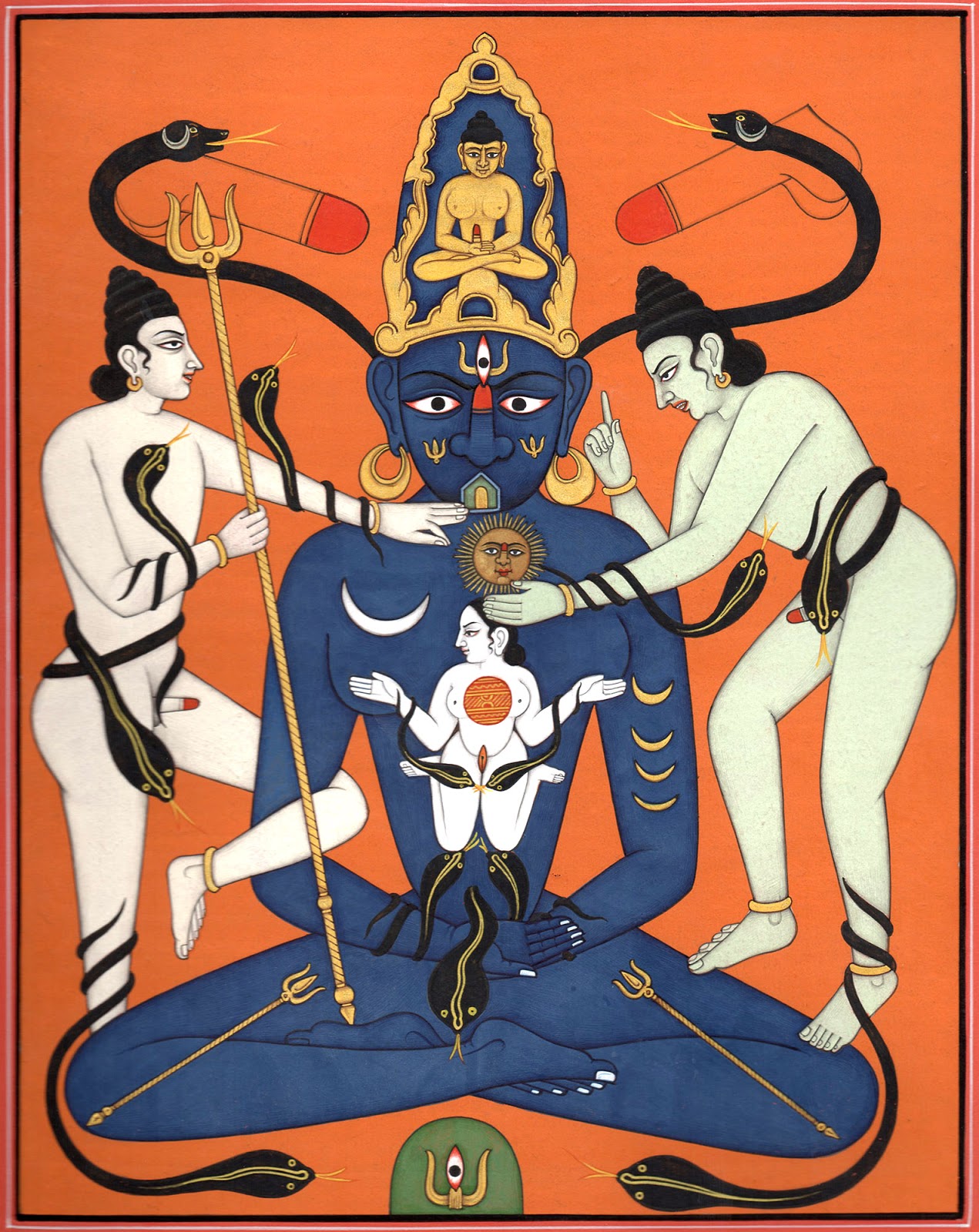
Guruji: Shaakti works by the Guru taking the Kuṇḍalinī Śakti through all chakras in the body of the devotee from Mūlādhāra in the genital to Sahasrāra on the crown of the head. There Kuṇḍalinī Śakti unites with Śiva. Their love produces a flood of amṛta as cosmic visions.

To generate such a flood of nectar, the mantras of the celestial lights of fire, sun, and moon are first invoked. Fire exists as sacred desire which creates life, as digestive energy, and as the creative power of moving time. The sun is in the heart; he moves through twelve zodiacal signs. The full moon is in the Sahasrāra; its slices are the digits of the moon, spread around the neck.

The life of the five cosmic elements — bhūmi, apas, anila, anala, nabhas — and their presiding deities Brahmā, Viṣṇu, Rudra, Īśvara, and Sadāśiva, and the Power of Time Śrī Devī; Amṛta kalās, Sarasvatī, Lakṣmī, Pārvatī, Mokṣa kalās — all are imagined by the Guru to be placed in the body of the devotee at appropriate places.

This kalā-āvāhana empowers the devotee by the light of the mantras.

You have all the freedom in the universe


“My guru gave me total freedom; how can I do any different?” Guruji would say. “Use the mantras and rituals I teach you whenever and however you want. There is no requirement forcing you to somehow lead your life differently.”
Indeed, he extended this laissez-faire approach far beyond his guru’s original concept, applying it to a broad spectrum of spiritually related behaviors.
Even vegetarianism, a virtually universal practice among traditional south Indian Brahmins, is not a prerequisite for Sri Vidya initiation according to Guruji. Though personally a lifelong vegetarian, he shrugged it off as a “cultural habit” of his family, caste and region—not a spiritual one.
“Non-vegetarians are eligible devotees, too,” he said. “I used to argue that, out of the 10 avatars of Vishnu, only Vamana the Dwarf is a vegetarian Brahmin; all the others are non-vegetarians. So it is a case of vegetarian devotees worshiping a non-vegetarian god!” He laughed. “Why is this? Why can’t a non-vegetarian devotee worship a non-vegetarian god or goddess? Ahimsa, is it? Non-violence? Vegetables like the kushmanda (a red pumpkin common in south India) can live for a full year after being separated from the plant. They experience pain and pleasure too, even if they can’t express it in terms we understand. Himsa [injury, harm] cannot be avoided. It is part of life. Life consumes life; that is the rule. We can’t eat inorganics and live.”
It was a viewpoint fully consistent with Guruji’s general disinterest in the mundane social markers of one’s spiritual path—whether they concerned dress, diet or anything else.
While he never rejected such practices outright, he did advise caution about attitudes and practices that emphasize divisions between people, or that act as “first you must do this” obstacles to the free exploration of one’s spirituality. This philosophy even goes a long way toward explaining his own simple form of dress. “To put on distinctive religious garb and set oneself apart from the rest of mankind certainly flatters the vanity of one’s tribe,” he noted. “But is it spirituality?”

Physical austerity as a pathway to God drew a similar note of caution. “Asceticism is not a requirement for spiritual development,” he said. “Austerities are as much of a waste of time as an overfull belly.” 


When a sleekly muscled young male visitor to Devipuram once attempted to elicit Guruji’s opinions on the benefits of advanced hatha yoga practices, Guruji laughed and replied, “You’re talking to the wrong guy! I’m not really built for it!”
When another expressed determination to undertake a strict spiritual fast, Guruji remarked, “It might be good for you, but only because you need to prove to yourself that you are capable of it.”
The dos and don’ts of spirituality, he continually stressed, must come from within.

“All religions seem to preach that there are certain things you should or should not do,” he said. “But who is to be the judge? I think that you, as a divine personality, should judge for yourself what you ought and ought not to be doing. Every conscious decision you make says something about the type of lifestyle you want to lead: whether you should or should not have sex, eat meat, drink alcohol, have coffee— whatever it may be; all the good things and bad things. You are the only person who can decide and tell yourself. Anything in moderation—just don’t hurt yourself, don’t hurt others and don’t hurt the environment. Other than that, you are free to do what you want. This is the fundamental basis of all results in Tantra.”

Our spiritual journey, Guruji taught, can only begin from where we are at this very moment. If any particular mode of eating, dressing or behaving inspires us, focuses us, gives us a sense of community, or makes us feel happier—then by all means, we should indulge as we see fit.
What we should never do is allow such outward signifiers to function as a prerequisite (or substitute) for spirituality itself, or a vehicle for feeling superior to others who dress, eat or act differently.
“If a change has to happen, it will happen from within,” Guruji said. “You will be guided by Devi herself. Who am I to decide for you? You have all the freedom in the universe.”