
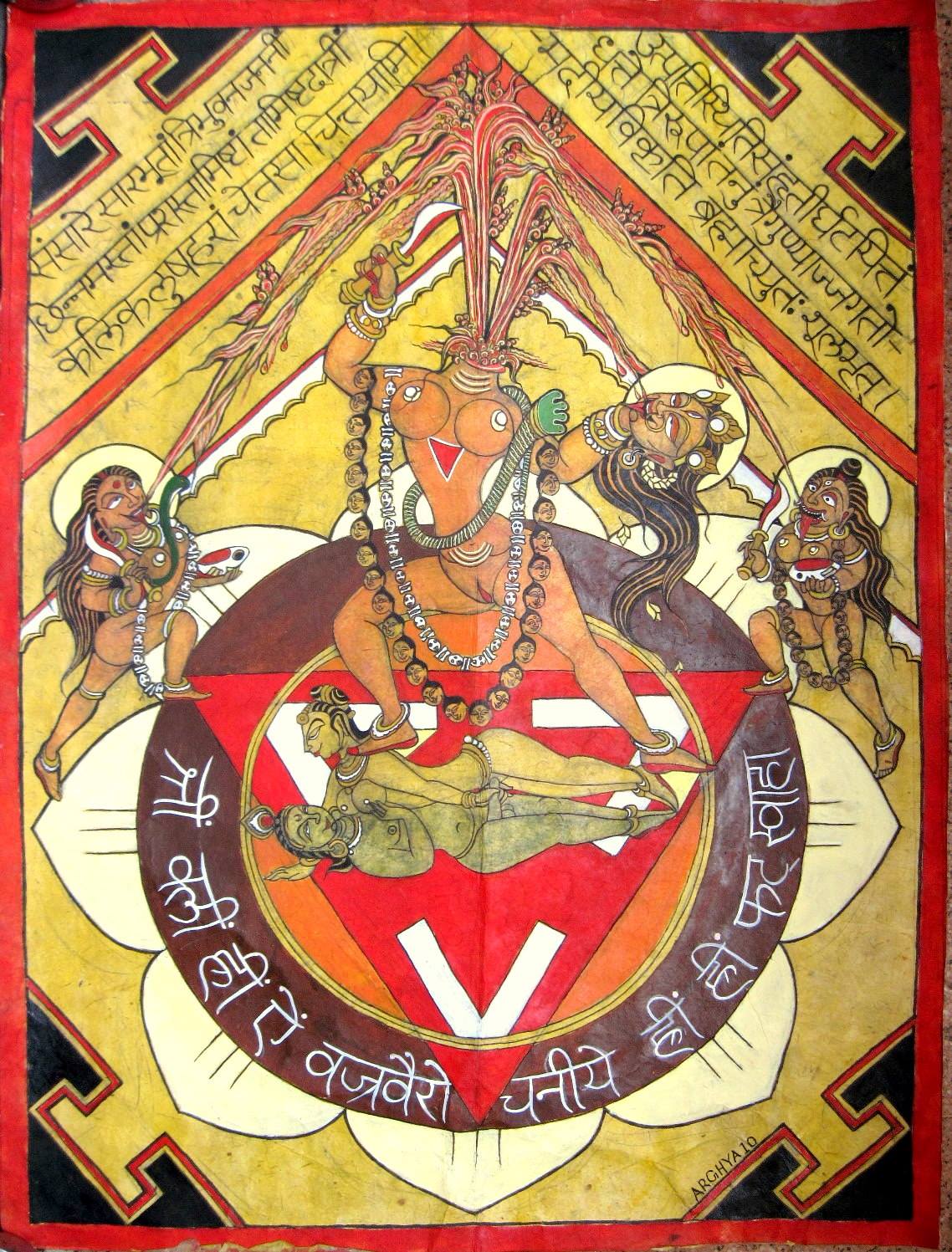
A flash, thunder, rain, rivers, green fields, flowers, fruits. The seed of God thrives on the fertility of Mother Earth, and life springs in the eternal bosom of Prakṛti for the vision of God. The flash separates the head from the body and three streams of blood sprout forth. The central stream is drunk by the head of the Goddess held in Her hand; the remaining two streams are drunk by Her aides.
The Goddess is standing on Rati and Manmatha in maithuna. Stark naked, Her nudity does not strike the eye as She is robed in dazzling light. She has no head: a headless trunk with two arms held aloft. From the headless neck three streams of blood gush forth. The middle stream is drunk by Her mouth in the severed head held in Her hand, while the other two streams are drunk by two attendants standing on either side. This is Pracaṇḍa Caṇḍikā or Chinnamastā. She is an invitation for lightning, thunderbolt to strike the body from head to foot. She gives kapāla mokṣa, yet She is living after death.
Prakāśa (Light) and Nāda (Sound) are the precursors of creation. When Prakāśa is delimited as Ākāśa, it is Bhuvaneśvarī. When the delimitation takes the form of duration, Time, it is Kālī. When Prakāśa gets involved in creation and at the same time transcends it, it is Sundarī. The unexpressed, unmanifest Sound in concentrated consciousness is Bhairavī, while the Sound perceiving itself is Tārā. The interaction of Prakāśa and Nāda to precipitate creation is Chinnamastā.
The interaction produces such force and violence that the creation is almost cut asunder from the creator. The whole purpose of creation is for the One to delight in separate existences as Many. This is why Chinnamastā is represented as cutting off the head (source).
In the world of phenomena, the interaction of Light and Sound results in thunder and lightning. Chinnamastā is the thunder destroying all the anti-divine forces. She is the hidden radiance in the heart of the cloud. Ruling over the cosmic mind, She acts through the human mind as the sense behind the senses. The most powerful activity of the senses is sex. The great Goddess is depicted as trampling with Her feet Rati and Manmatha joined in amorous union. Worship of Chinnamastā grants complete mastery over the sex-impulse.
Chinnamastā is the indomitable force, the striking power of the Supreme. What is the difference between Her action and the action of Kālī? When Kālī is fierce and terrible, She is Caṇḍī. Chinnamastā is more terrible than the terrible Kālī, hence the name Pracaṇḍa Caṇḍikā. Kālī works with the aid of Kāla (Time). Chinnamastā destroys instantaneously. Kālī is the prāṇa-śakti (vital force), while Chinnamastā is vidyut-śakti (electric force). She has Her seat between the eyebrows (Ājñā Cakra) and commands the power of will and vision.
Chinnamastā is the power of lightning (Vajra Vairocanī), and spreads Herself along myriads of channels enveloping the whole cosmos. When a being is created, this energy enters into the being through the Brahmarandhra. Brahmarandhra is the only aperture that connects the flow of energy in the body with that of the cosmos. The energy then spreads throughout the psychic body by means of nāḍīs. Of all the nāḍīs, the three important ones are Iḍā, Piṅgalā, and Suṣumṇā. Suṣumṇā is the central nāḍī that terminates in the Brahmarandhra.
Chinnamastā is in the concentrated form at the Ājñā Cakra. However, Her activity is in the Suṣumṇā, where She traverses up and down as the sustaining current of electric energy and power. The flow is restricted by the granthis. The knots have to be cut by the scissors which She holds in Her hand. Pracaṇḍa Caṇḍikā is the current through the Suṣumṇā, while the charming Vāriṇī and the terrific Ḍākinī are the currents through the Iḍā and Piṅgalā.
Chinnamastā manifested as the mother of Paraśurāma, the sixth avatāra of Viṣṇu. The story goes that at the behest of his irate father Jamadagni, who was displeased with the misdemeanour of his wife Reṇukā, Paraśurāma cut the head of his mother with an axe. Then, by virtue of a boon from his father, who was pleased with his unquestioning obedience, Paraśurāma got his mother alive.
The mantrā of the Goddess is the seed-sound Hūṁ, also known as the Dhenu bīja. The mantrā gives mastery over the senses and annihilates the mind completely. One effective way of sādhana is to imagine a constant downpour of lightning from the high skies and submit the whole body, mind, and self to it in absolute dedication and surrender.
It is a detailed answer to my long pending question with in me. Thanks and salutes Guruji.
ReplyDelete🌻🌻🌻🌻🌻🌻🌻🌻🌻🌻🌻🌻🌻🌻🌻🌻🌻🌻🌻🌻🌻🌻🌻🌻🌻🌻🌻🌻🌻🌻🌻🌻🌻🌻🌻🌻🌻🌻🌻🌻🌻🌻🌻🌻🌻🌻🌻🌻🌻🌻🌻🌻🌻🌻🌻🌻🌻🌻🌻🌻🌻🌻🌻🌻🌻🌻🌻🌻🌻🌻🌻🌻🌻🌻🌻🌻🌻🌻🌻🌻🌻🌻🌻🌻🌻🌻🌻🌻🌻🌻🌻🌻🌻🌻🌻🌻🌻🌻🌻🌻🌻🌻🌻🌻🌻🌻🌻🌻🌻🌻🌻🌻🌻🌻🌻🌻🌻🌻🌻🌻🌻🌻🌻🌻🌻🌻🌻🌻🌻🌻🌻🌻🌻🌻🌻🌻🌻🌻🌻🌻🌻🌻🌻💖💖💖💖💖💖💖💖💖💖💖💖💖💖💖💖💖💖💖💖💖💖💖💖💖💖💖💖💖💖💖💖🌹🌹🌹💖🌹🌹🌹💖🌹💖🌹💖🌹💖🌹💖🌹💖🌹💖🌹💖🌹💖🌹💖🌹💖🌹💖🌹💖🌹💖🌺💖🌺💖🌺💖💖🌺💖🌺💖🌺💖🌺💖
ReplyDelete